
Addressing the Competitive Challenge of China
For the domestic auto industry, this is not theoretical.
By Gary S. Vasilash
One of the things I find most concerning about the rhetoric against allowing Chinese vehicles into the U.S. market is that it generally points fingers at the Chinese government and then warns that the U.S. industry will be absolutely destroyed should the Chinese vehicles come rolling onto our shores.
And that’s pretty much all that is said.
The finger-pointing is the most troubling.
The point is that the Chinese government has given its country’s automakers—its electric vehicle producers, in particular—with funding, as part of that country’s industrial policy.
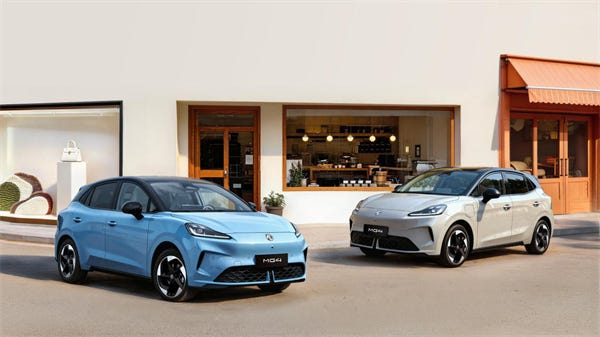
MG4 is available as both a full EV and hybrid. MG is owned by SAIC. (Image: SAIC)
According to a piece by Scott Kennedy of the Center for Strategic & International Studies (CSIS) published in June 2024, from 2009 to 2023 the spending in support of the Chinese EV sector was a—and I hesitate to use the word were it not so apt—a whopping $230.9 billion.
The CSIS identifies five categories of support:
· Rebates
· Sales tax exemptions
· Infrastructure subsidies
· Research and development
· Government procurement
Of the five, the sales tax exemption is the most significant: $117.7 billion. The sales tax is for those not getting an EV was otherwise 10%.
And those five are not the only means by which there is government support of the EV industry.
· There are local rebate programs from cities and municipal areas
· There are often low-cost land, electricity and credit on offer for the manufacturers
· There is investment by municipal and provincial governments in EV manufactures
· There are subsidies for other parts of the supply chain, ranging from mining raw materials to transforming them into batteries
Now none of those things are outlandish. That they seem to result in pearl-clutching by some people in the U.S. (“Gasp! We will be devastated!”), doesn’t it occur to them that the Chinese government is a one-party socialist republic, and as such it moves the levers of industry at will?
In addition to which, in China over the past few decades there was a move toward state capitalism, where there are private sector companies but a decided interest by the Chinese government in those industries.
What’s more—and this is really more—there are SOEs—State-Owned Enterprises.
Automotive SOEs include SAIC Motor, FAW Group, Dongfeng Motor Corp, Changan Automobile, GAC Group, BAIC Group, and Chery Automobile.
The government has a decided interest in the success of these companies.
EVs have been a part of the Chinese government’s five-year plans since 2011 (2011-2015; 2016-2020; 2021-2025). Apparently, the current plan (2026-2030) leaves them out because of the existing overcapacity. Perhaps this means the previous plans did a good job.
While things like five-year plans and even said-out-loud “industrial policy” aren’t part of the U.S. approach, let’s face it: the government does do things to facilitate manufacturing companies and one could argue that it is industrial policy.
Of late there are the cases of the Trump Administration allowing the acquisition of U.S. Steel by Nippon Steel only after the government got a so-called “golden share” that allows the President to veto plant closures or idling, select a board member and reject others, and have other control over what is ostensibly a private company.
Also recently was the 9.9% equity stake the government took in Intel Corporation. Although it is a passive investor in this case, as the U.S. Government is now the single-largest shareholder in Intel, it has more than passing interest in the success of the semiconductor manufacturer.
So if the Chinese auto industry is an existential threat to the U.S. auto industry, then why doesn’t the U.S. government do something about it—something big?
For years states and local municipalities have provided incentives to get assembly plants.
To get the Hyundai Metaplant built in Ellabell, Georgia, the state and county governments put together a $2.1 billion incentive package including property tax abatements, sales tax exemptions, and more. (Yes, Hyundai has to deliver on things like jobs or it has to pay some of the benefits back.)
Rivian received a package valued at $1.5 billion to build a plant in Stanton Springs, Georgia, again with participation of the state and local governments.
(Evidently the people in Georgia and fairly clever to get two important plants in fairly short order.)
But what about the Federal government?
Things like the Connected Vehicle Security Act of 2026, a bipartisan bill in Congress that will effectively ban Chinese vehicles in the U.S., is a good thing, but it doesn’t address the problem of Chinese advanced technology and overabundance of production capacity.
The U.S. economy is still much larger than the Chinese economy, so let’s not lose sight of that.
Arguably the government has the wherewithal to manage
· Rebates
· Sales tax exemptions
· Infrastructure subsidies
· Research and development
· Government procurement
on behalf of the auto industry that can help advance things.
So shouldn’t all—or some of those—be put into play sooner rather than later?
If the auto industry is critically important to the U.S.—and it is—why not a “Moon Shot” to propel it forward—way forward?
In addition to which, the industry itself should rethink what competition is and who the competitors are.
This is apparently something leaders of the Japanese auto industry recognize.
In March the new board of the Japanese Automobile Manufacturers Association (JAMA) held a press conference.
During the event, Toshihiro Mibe, president, CEO and representative director of Honda Motor Co., Ltd., and JAMA vice chairman, observed:
“In terms of the global competitive environment, we are fully aware that Japan’s automotive industry is operating on the edge — facing intensifying competition every single day.
“The key to survival will be how quickly we can advance initiatives in the areas where collaboration is essential.
“At the same time, when we look back, the structure of our industry has long been vertically segmented: automakers at the top and suppliers under them, a hierarchy built over decades. Within such a context, the traditional approaches to competition and collaboration are no longer sufficient. We are now actively discussing the need to break away from these historical structures, because without doing so, new competitiveness cannot emerge. To be candid, this remains one of our greatest challenges.”
How is the U.S. auto industry any different in terms of the “intensifying competition”?
Isn’t “survival” on the table (credit to Jim Farley, Ford CEO, for pointing that out on a regular basis)?
Isn’t speed—as in “how quickly we can advance initiatives”—critical?
If “traditional approaches to competition and collaboration are no longer sufficient” in Japan, can’t the same case be made for the U.S.?
The challenge is real. The means by which that challenge can be met and ideally bested are probably no longer the ones that worked in an earlier age, as much as some would like to think they still are.
I was just doing some writing about this topic this morning. the biggest existential threat to the US automaker, I'm convinced is the US automaker and it's love affair with margin from larger, luxury automobiles.